

01.04.2025
Anthology

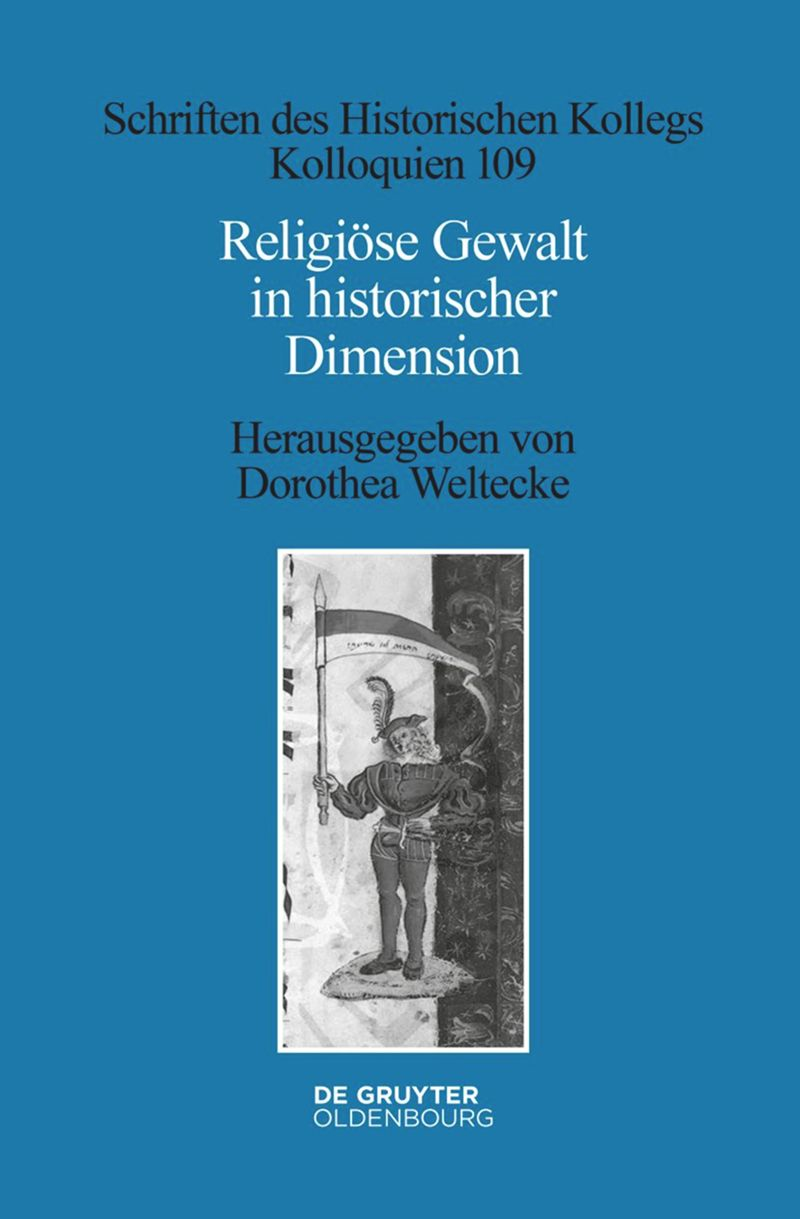
Religious violence in a historical dimension

About the book chapter:

What is religious violence? For the first time, historians are consistently pursuing this question using their own methods. They question the usefulness of definitions of religious violence and examine the relationships between the exercise of violence, its religious framing and legitimization. By analyzing different times, cultures and regions, they reveal specific characteristics of religious violence. The contributions address well-known phenomena such as Roman gladiator fights, the persecution of religious groups in the Middle Ages or the First World War, but also forms of violence that have hardly been dealt with to date. Above all, the authors question traditional assumptions. They historicize concepts and deconstruct theories. In the end, new questions and methodological suggestions are provided for further research into an enduring problem of our time.
News from the research center

Publication
12.05.2026 | Online article

Disinhibited Informalization: Talk Radio, Bro Podcasts and the Aesthetics of Populism

This essay by Johannes Völz is a revised and updated translation of “Enthemmte Informalisierung: Talk Radio, Bro-Podcasts und die Ästhetik des Populismus,” WestEnd: Neue Zeitschrift für Sozialforschung 22.2 (2025): 3–24. It is published here as part of the b2o Review’s “Stop the Right” dossier.

more information ›
Event
20.05.2026 | Frankfurt am Main

Von der Selbstermächtigung zum sozialen Widerstand

Lecture

Vortrag von Prof. Dr. Axel Honneth (Frankfurt am Main / New York Columbia University) mit anschließender Diskussion im Rahmen des Rechtstheoretischen Mittwochsseminars von Klaus Günther, Dan Wielsch und Benno Zabel.

more information ›
Event
19.05.2026 | Frankfurt

Speculative Truth Regimes

Panel Discussion

Event with Adam Kahlil (New Red Order) and Toby Lee (NYU) as part of the Series Visual Truth Regimes, organized by Laliv Melamed (Goethe University Frankfurt, Normative Orders), Felix Trautmann (Institut für Sozialforschung; HBK Braunschweig) and Franziska Wildt (Institut für Sozialforschung).

more information ›
Event
25./26.06.2026 | Frankfurt

Shifting Regimes, Changing Orders

Conference

Conference as part of WDC2026 in collaboration with Deutsche Gesellschaft für Designtheorie und -forschung (DGTF), Kunstgewerbemuseum/Design Campus SKD and Design and Democracy

more information ›
Event
28./29.05.2026 | Frankfurt am Main

Global Health Justice: Principles and Practice

Conference

Following the research focus of the Global Health Justice Postdoctoral Programme, funded by Höppsche Stiftung, the "Global Health Justice: Principles and Practice" conference places a particular emphasis on themes such as the human right to health, political activism and health justice issues, and problems of structural injustice and vulnerable populations in health care. Keynote lectures by Jonathan Wolff and Kanchana Mahadevan. The Global Health Justice Programme and this conference are supported by the Höppsche Stiftung in Villmar.

more information ›
Event
14.07.2026 | Frankfurt am Main

Democracy Over Time and the Climate Crisis

Lecture Series

Vortrag von Anja Karnein (Binghamton). Die Vortragsreihe untersucht Fragen der Klimakrise als Herausforderungen für demokratische Gesellschaften und konzentriert sich auf Themen wie politische Legitimität, Widerstand gegen fossile Brennstoffe und die Interessen künftiger Generationen. Sie wird organisiert von Prof. Dr. Darrel Moellendorf und Dr. Lukas Sparenborg.

more information ›
Event
10.06.2026 | Frankfurt am Main

Capital Investment, Inequality, and State Power in a Time of Climate Emergency

Lecture, Lecture Series

The lecture series examines questions of the climate crisis as challenges for democratic
societies and focuses on issues of political legitimacy, fossil fuel resistance, and the interests
of future generations.

more information ›
Event
23.06.2026 | Frankfurt am Main

Wehrhafte Demokratie: Chancen und Grenzen des Parteiverbots

Panel Discussion

Im Mittelpunkt des Abends steht die Frage, ob und unter welchen verfassungsrechtlichen, politischen und gesellschaftlichen Voraussetzungen ein Verbot einer demokratisch gewählten, rechtsnational ausgerichteten Partei als legitimes Mittel in Betracht gezogen werden kann oder nicht. Ausgehend von den normativen Grundlagen des Parteienverbots im Grundgesetz, möchten wir die hohen rechtlichen Hürden und demokratietheoretischen Spannungsfelder dieser Maßnahme erörtern – zwischen Pluralismus und Selbstverteidigung, zwischen Meinungsfreiheit und Schutz der freiheitlichen demokratischen Grundordnung.

more information ›